Home

Prediction Markets
at Interactive Brokers

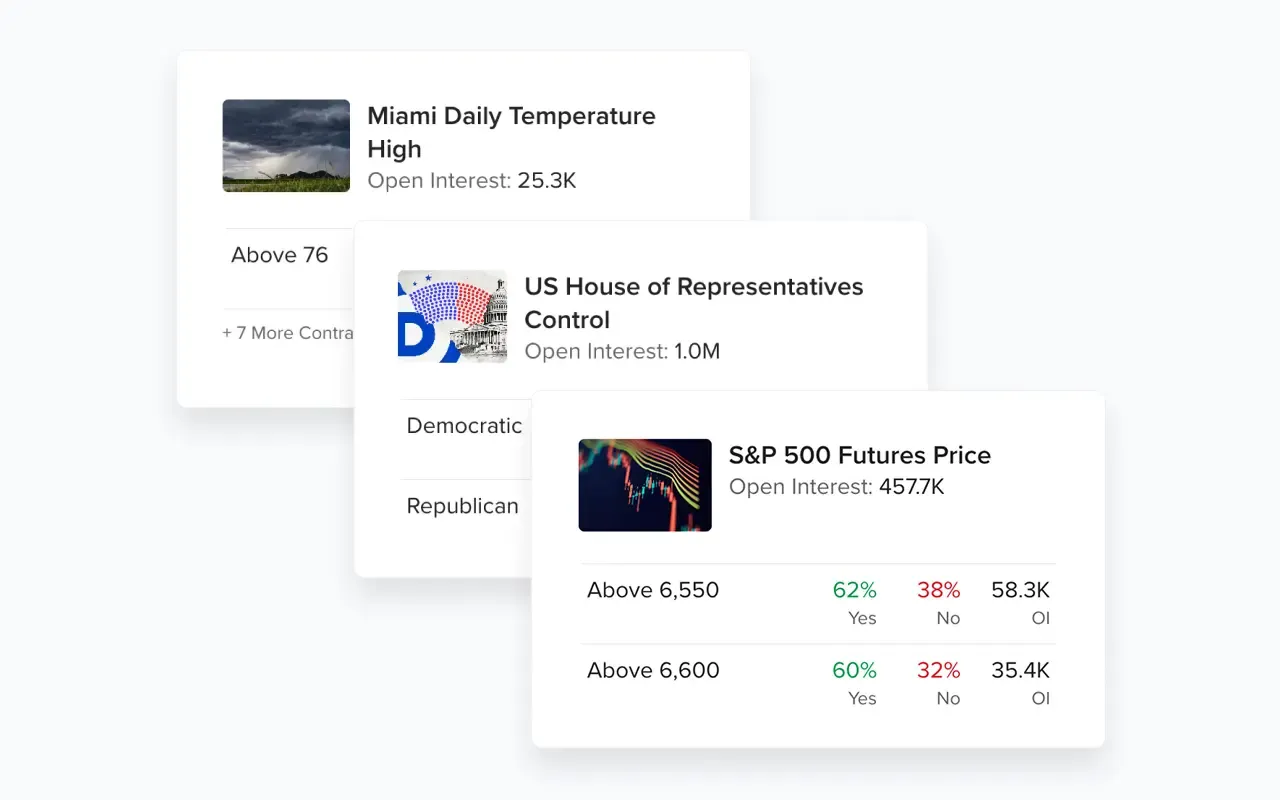
Trade prediction markets on political,1 climate, and
economic events - where prices reflect probability.

Let prediction markets inform your next portfolio move.

Featured Prediction Markets

  1. Politics
    Will the Republican Party win a majority in the United States House of Representatives in the 2026 general election?
    Yes YES No NO
  2. Financial Markets
    Will the highest price of Bitcoin exceed $130,000 this year?
    Yes YES No NO
  3. Environmental
    Will this year be the warmest year on record?
    Yes YES No NO
  4. Economic Indicators
    Will the Fed lower the rate 25bps in this month?
    Yes YES No NO
View Markets

Trade the Future —
One Event at a Time

What Are Prediction Markets?

Prediction markets let participants trade on the outcomes of future events. Each contract represents a defined outcome, and prices reflect the collective probability.

Why Prediction Markets Matter

Prediction markets offer a structured, transparent way to express views on events such as politics, climate, and economics. Interactive Brokers provides the tools and platform to trade with confidence.

Why Trade Prediction Markets
at Interactive Brokers?
Trade Every Asset Class from One Platform

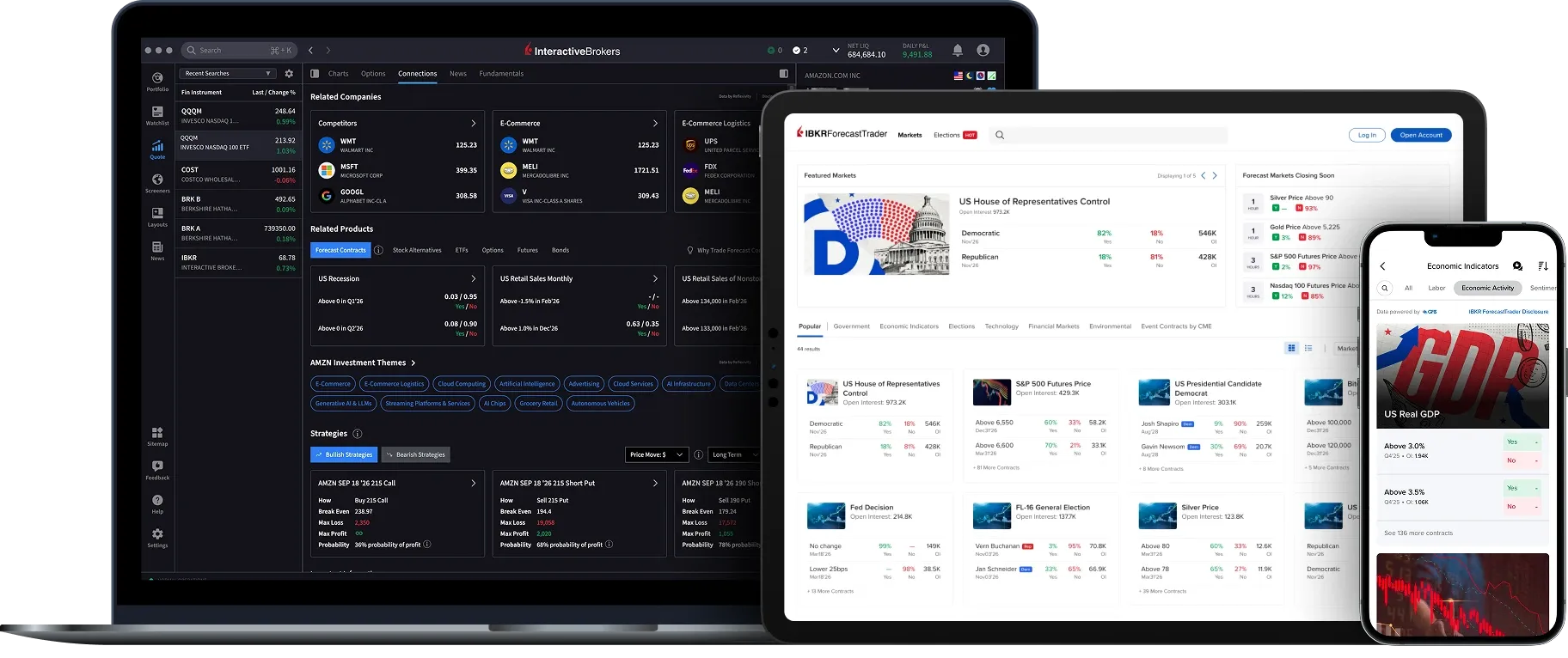
Trade prediction markets alongside stocks, ETFs, options, currencies, and bonds from a single unified platform — and apply those insights across your portfolio.

Earn Interest on Prediction Markets

Earn interest based on the market value of your positions. Interest accrues daily at the current rate of USD 3.14% APY and is paid monthly.

Competitive Prediction Markets Trading Costs

A fee of $0.01 per contract applies.

Advanced Trading Tools for Prediction Markets

Use IBKR’s ScaleTrader algorithm to efficiently scale into large positions by buying at lower prices or selling at higher prices.
Learn More About
Prediction Markets

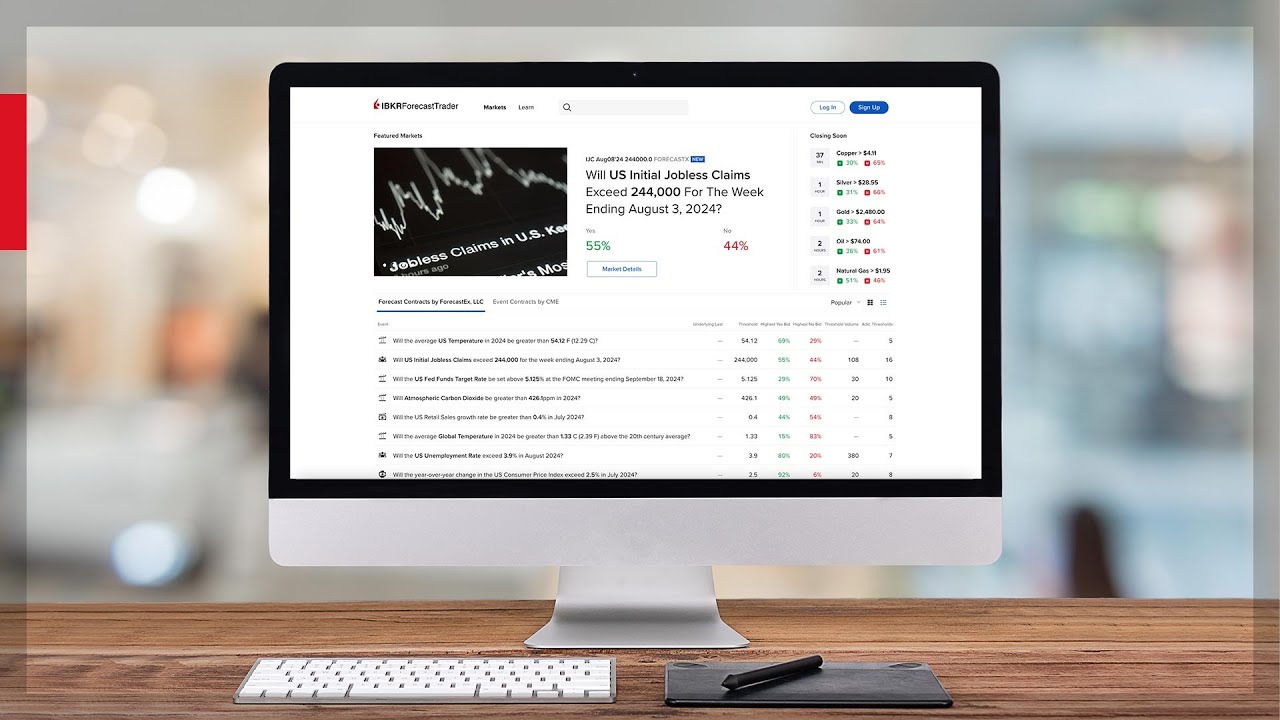
Explore free IBKR Campus lessons to learn further how prediction markets work.

Trading Prediction Markets at IBKR

Practical Use of Prediction Markets

Hedging Economic and Climate Risks

Take the First Step with Prediction Markets

New to Interactive Brokers?
Get $3 to trade prediction markets.

Upon account opening, accounts receive $3 for their first trade.

Frequently Asked Questions

US election prediction markets are markets where participants trade Yes/No contracts tied to US election outcomes, and prices update as information changes. On ForecastTrader, these are ForecastEx Forecast Contracts presented as clear, outcome-based questions with fixed settlement values.

No — Forecast Contracts on US election results are only available to eligible US residents, and additional eligibility requirements may apply.

Election prediction markets work by letting you take a position on a specific yes-or-no election question (for example, who wins, which party controls a chamber, or whether a candidate wins a state — depending on listings). If the outcome resolves in your favor, the contract settles at a fixed value (commonly $1) and otherwise settles at $0, subject to the contract's terms.

In Forecast-style election markets, the "odds" people refer to are typically the current contract price, and that price is commonly interpreted as an implied probability signal. Because prices update continuously, you can track live election probabilities and see how market expectations shift in real time.

An election probability tracker is a way of viewing how market pricing changes over time for a given election question — effectively a real-time election prediction signal derived from trading activity. ForecastTrader surfaces these probabilities through Forecast Contract prices and percentage-style displays based on market sentiment

"Real-time election predictions" usually means continuously updating market-based probabilities that react quickly to new information (news, debates, polling releases, court decisions, etc.). Unlike a single poll, market prices can change any time participants re-price the likelihood of an outcome.

No — polls measure stated voter preference at the time of a survey, while prediction markets reflect what participants are willing to pay for a yes/no outcome at that moment. Many traders also incorporate polls, fundamentals, and news into their decisions, so market prices can move in response to polling changes.

They're different tools: polls are snapshots of opinion; markets are dynamic probability signals that can incorporate many information sources. Market quality depends on participation, liquidity, and contract design — so the best approach is often to use both as complementary inputs.

They can be — research finds prediction markets are often fairly accurate and can outperform common benchmarks in many contexts, though they aren't perfect and outcomes can still surprise. Accuracy is influenced by liquidity, clarity of settlement rules, and how much new information arrives late in the cycle.

Yes — a high implied probability is not a guarantee; it reflects the market's current consensus given available information and trading behavior. Unexpected events (late-breaking news, turnout shifts, legal rulings) can still change outcomes

ForecastEx Forecast Contracts are exchange-listed contracts that let you trade on yes-or-no event questions across politics (including US elections where eligible), economics, finance, and climate indicators. They typically settle at $0 or $1 based on the outcome.

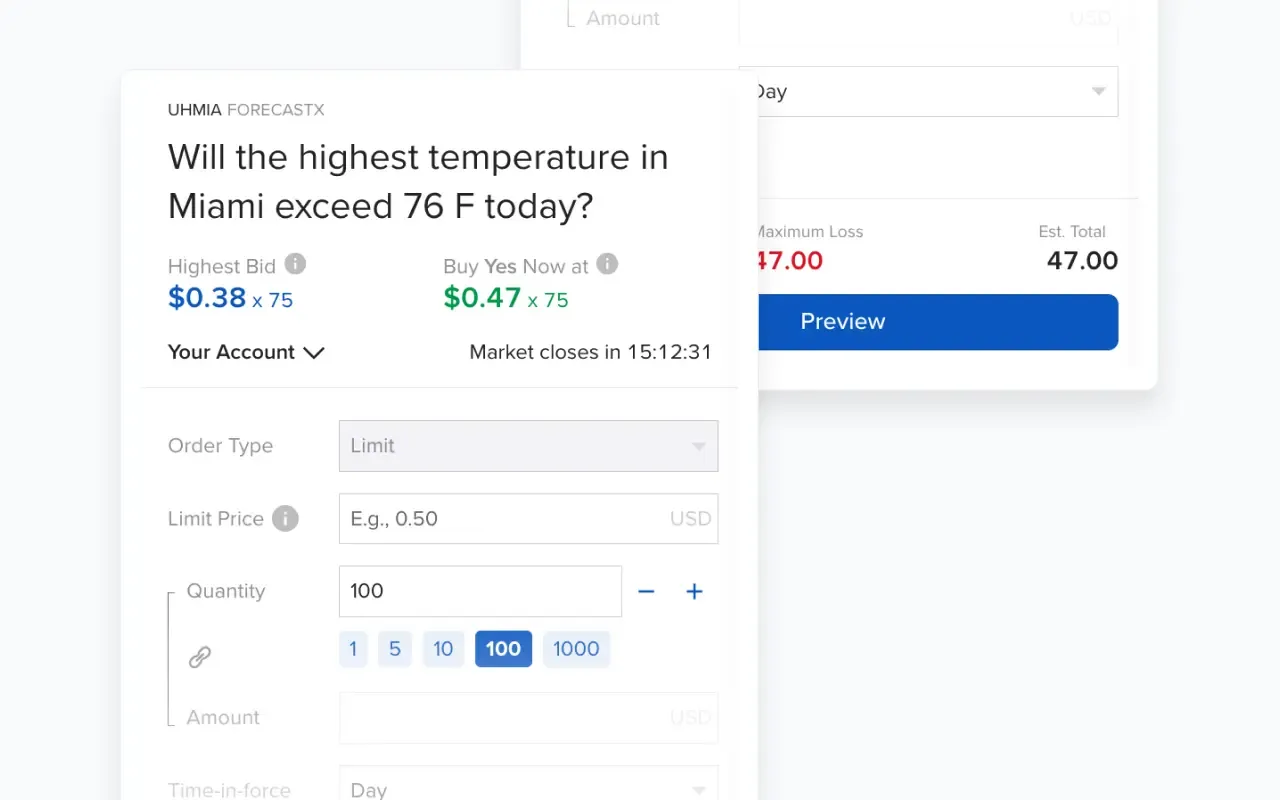
Forecast Contracts are priced in dollars and quoted in small increments, with prices generally between about $0.02 and $0.99 depending on the market's perceived likelihood. A higher "Yes" price typically indicates the market views the event as more likely, based on real-time trading.

Your maximum loss is generally limited to the amount you paid for the contract, because these contracts are designed with fixed settlement outcomes (subject to fees and applicable rules). ForecastEx also describes these contracts as fully collateralized structures.

The maximum profit per contract is generally the settlement value (typically $1) minus your purchase price (and any applicable costs).

At settlement, the contract resolves according to the event question and the exchange's rules, paying out the fixed settlement value to the correct side. This is why reading the event question (and what source determines the outcome) matters.

ForecastEx disclosures describe exiting via offsetting positions (holding both "Yes" and "No" sides of the same event question), with settlement handled per exchange rules. In practice, the ability to exit efficiently depends on market liquidity and the available prices at that time.

ForecastTrader states trading is available around the clock, seven days a week, though the system may have periodic maintenance windows.

The home page states Forecast Contracts are offered at zero-commission at Interactive Brokers. (As with any market, bid/ask spreads and market liquidity can still affect your execution price.)

ForecastTrader states Forecast Contracts pay an interest-like incentive coupon that accrues daily and is paid monthly, and shows a current rate of 3.14% APY. The coupon is based on the closing market value of positions, per the platform description.

ForecastTrader describes that customers may need the appropriate trading permissions and that ForecastTrader is accessible through IBKR platforms and web experience. Eligibility and permissions can vary by customer type and jurisdiction.

Economic prediction markets are forecast markets where participants trade yes/no contracts on measurable economic outcomes like inflation thresholds, rate decisions, or recession timing (depending on listings). ForecastTrader examples include questions tied to CPI and the Fed Funds Target Rate.

ForecastTrader and ForecastEx examples include inflation indicators, interest-rate targets, and growth-related metrics (depending on what's listed). Each contract is tied to a clear event question and a defined resolution process.

Markets estimate probability through trading: prices move as participants incorporate new data releases, forecasts, and macro news into what they're willing to pay. ForecastTrader also highlights that the "Yes" price is based on how likely an event is to happen.

Climate prediction markets are forecast markets where participants trade on measurable climate indicators (for example, temperature or atmospheric CO₂ thresholds), depending on listings. ForecastTrader includes climate indicators like temperatures and atmospheric CO₂ as examples.

People may use climate forecast markets to track the market's collective expectation about measurable outcomes over a defined timeframe. As always, the contract's definition and settlement source determine what "counts" as the outcome.

Yes — these are derivatives and you can lose the full amount paid for a position if the outcome resolves against you. ForecastTrader also states these products are not suitable for all investors and points to risk disclosures

Check the event question, the deadline, and the settlement/resolution source so you understand exactly what determines the outcome. This is especially important for closely related outcomes (e.g., popular vote vs. electoral outcomes) where definitions matter.

No — forecast contracts are event-based derivatives with fixed settlement outcomes tied to a question, not ownership in a company. They're designed to express a view on an event outcome with predetermined payoff structure.

Disclosures

  1. Forecast Contracts on US election results are only available to eligible US residents.

Forecast Contracts are only available to eligible clients, 21 years and older, of Interactive Brokers LLC, Interactive Brokers Canada Inc., Interactive Brokers Hong Kong Limited, Interactive Brokers Ireland Limited and Interactive Brokers Singapore Pte. Ltd.

FOLLOW US